
Summer is here. And so is your melasma — darker, more stubborn, and harder to hide.
You are not imagining it. Melasma typically darkens in summer and improves in winter. This seasonal pattern is one of the most frustrating aspects of this condition.
At our Chowk clinic, we see this every year. Patients walk in with patchy brown or grey-brown spots on their cheeks, forehead, and upper lip — all significantly darker than just a few months ago.
The question is always the same: “Why is my melasma getting worse? What am I doing wrong?”
The truth is, you may not be doing anything wrong. Summer brings a combination of triggers that work together to stimulate pigment production. Understanding these triggers is the first step to protecting your skin.
In this guide, we will break down 5 key reasons why your melasma worsens in summer — and what you can do to stop it.
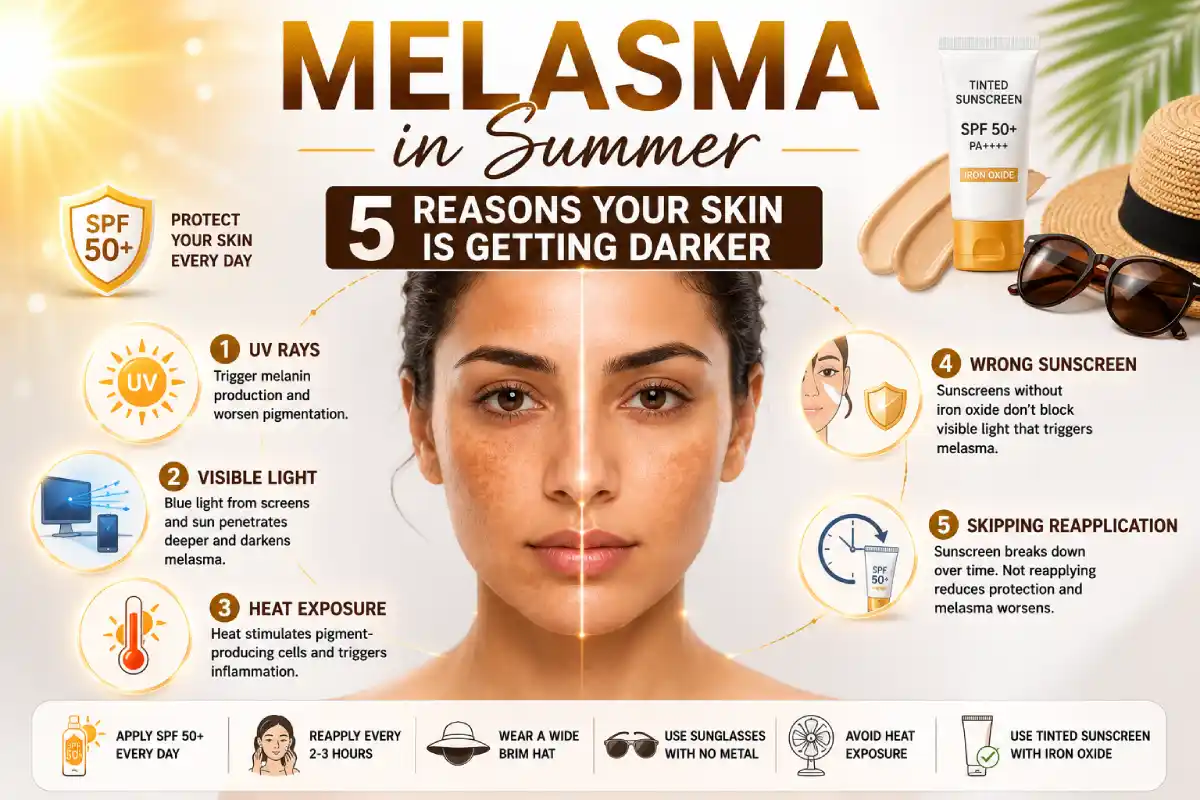
Reason 1: UV Rays Trigger Melanin Production
Ultraviolet (UV) radiation from the sun is the most well-known trigger for melasma . When UV rays hit your skin, they stimulate the cells responsible for producing melanin. The result? Darker, more pronounced patches.
UV radiation directly stimulates melanin production, worsening pigmentation . This is why sun protection is non-negotiable for anyone with melasma.
What you can do:
- Apply a broad-spectrum sunscreen with SPF 50+ every single day
- Look for “broad-spectrum” on the label — this means it protects against both UVA and UVB rays
- Reapply every 2-3 hours, especially when outdoors
Common mistake: Applying sunscreen only once in the morning and thinking you are protected all day. Sunscreen wears off through sweat, oil, and natural breakdown.
Reason 2: Visible Light Penetrates Deeper Than UV
Here is something many people do not know.
Visible light makes up 45% of the sunlight spectrum and can penetrate deeper into your skin than UV rays. This includes blue light from your phone, laptop, television, and overhead lamps.
Visible light can induce both immediate and persistent skin darkening, especially in individuals with skin of colour. Unlike UV, which is blocked by glass windows, visible light passes right through.
What you can do:
- Switch to a tinted sunscreen that contains iron oxide. Iron oxide blocks visible light up to 700 nm, including blue light.
- Close the sunroof shade when driving – visible light penetrates glass
- Consider reducing screen time or using blue-light blocking glasses
Studies show: In one 12-week study, 36% of melasma patients using SPF 50+ with iron oxide showed improved skin radiance, compared to 0% in the SPF-only group.
Reason 3: Heat Stimulates Pigment-Producing Cells
Heat is a surprisingly common — and often overlooked — trigger for melasma .
When your skin is exposed to heat, blood vessels dilate. This leads to inflammation, which in turn stimulates pigment-producing cells . Heat itself can worsen hyperpigmentation disorders like melasma, even without direct sun exposure .
Hidden sources of heat: Overhead work lights, desk lamps, cooking over an oven or grill, hair dryers, and even the metal rims of sunglasses left in a hot car . I always ask my melasma patients to check their sunglasses for metal — the heat transfers to the skin and can trigger patches that follow the pattern of the glasses .
What you can do:
- Avoid direct heat sources on your face
- Let sunglasses cool down before wearing them
- Use fans or air conditioning to keep your skin cool
- Take breaks from cooking heat and step away from the stove
Reason 4: Sunscreen Without Iron Oxide Does Not Block Visible Light
This is a major gap in most people’s sun protection routine.
Standard sunscreens — even SPF 50+ — protect against UVB and UVA rays. But they do not protect against visible light. Mineral sunscreens with zinc oxide or titanium dioxide scatter visible light, but only up to around 400 nm.
Iron oxide, found in tinted sunscreens, is different. It protects a large portion of the visible light spectrum all the way up to 700 nm — including the blue light that triggers melasma.
What you can do:
- Switch to a tinted sunscreen with iron oxide
- Look for products specifically formulated for melasma-prone skin
- Apply generously and reapply throughout the day
Expert recommendation: Dermatologists now recommend tinted sunscreens as the first line of defense for melasma patients. Visible light protection is essential for managing this condition.
Reason 5: Skipping Reapplication Reduces Protection
Even the best sunscreen becomes ineffective if you do not reapply.
Sunscreen breaks down over time. Sweat, oil, and rubbing your face all reduce its effectiveness. Melasma patients need consistent, year-round protection, and reapplying is a critical part of that strategy.
What you can do:
- Reapply sunscreen every 2-3 hours when outdoors
- Reapply immediately after sweating or wiping your face
- Keep a travel-size sunscreen in your bag for convenience
- A mineral-based SPF powder works well for quick touch-ups on top of your makeup.
The rule: One application in the morning is not enough. Protection needs to be maintained throughout the day.
How to Protect Your Skin This Summer
Here is a practical checklist to prevent your melasma from worsening:
| Action | Why |
| Switch to tinted sunscreen | Blocks visible light with iron oxide |
| Apply SPF 50+ every morning | Protects against UV damage |
| Reapply every 2-3 hours | Maintains continuous protection |
| Wear a wide-brimmed hat | Physical barrier against sun exposure |
| Avoid peak sun hours (12 PM – 4 PM) | Reduces UV and heat exposure |
| Use sunglasses with no exposed metal | Prevents heat transfer to cheeks |
| Avoid scented soaps and skincare products | Some cosmetics can trigger melasma |
| Take breaks from heat sources | Heat stimulates pigment production |
When Home Care Is Not Enough
Sometimes, prevention and home care are not sufficient.
At Dr. Asma Skin Clinic, we offer professional treatments for melasma that can help lighten existing patches and prevent recurrence:
| Treatment | Best For |
| Cosmelan peel | Stubborn melasma, deep pigmentation |
| Chemical peels | Surface pigmentation, sun spots |
| Q-Switch Nd:YAG laser | Deep, resistant pigmentation |
| Prescription creams | Hydroquinone, tretinoin, kojic acid combinations |
| Tranexamic acid | Oral or topical for vascular melasma |
| Tinted sunscreen (medical-grade) | Daily protection with iron oxide |
Frequently Asked Questions
Q: Does sunscreen alone prevent melasma?
A: No. UV protection is essential, but you also need visible light protection — which comes from iron oxide in tinted sunscreens. Heat avoidance is also important .
Q: Why does my melasma get darker in summer even with sunscreen?
A: Your sunscreen may not protect against visible light. Consider switching to a tinted sunscreen with iron oxide. Also, check for heat exposure from cooking, driving, or even sunglasses.
Q: Can melasma go away on its own?
A: It may fade after pregnancy or with consistent sun protection, but it often requires treatment to fully resolve .
Q: Is laser safe for melasma?
A: Yes, but only with the right settings. Aggressive lasers can worsen melasma. Always choose an experienced dermatologist .
About Dr. Asma Parveen
Dr. Asma Parveen is a board-certified dermatologist with 14+ years of experience in Lucknow. She specializes in pigmentation disorders, melasma treatment, and post-acne dark spots .
At our Chowk clinic, We offer:
- Accurate melasma diagnosis
- Customized treatment plans with peels, lasers, and prescription creams
- Medical-grade tinted sunscreens with iron oxide
- Long-term prevention strategies
Ready to Take Control of Your Melasma This Summer?
Do not let another summer make your melasma worse. With the right protection and treatment, you can keep your skin clear and even.
Visit our Clinics:
Dr. Asma MD Skin Clinic – Chowk, Lucknow
Subhash Chandra Bose Complex, Mandi Crossing, Victoria Street, Chowk Lucknow – 226003
Dr. Asma Skin & Hair Clinic – Thakurganj, Lucknow
Near Ghante Wala Sweets, Daulatganj Thakurganj, Lucknow – 226003
Dr. Asma Skin Clinic – Barabanki
Mohalla Ayodhya Nagar, Naka, Satrikh, Barabanki – 225001
Call/WhatsApp to Book Your Appointment: +91-9335312242
New patients: 10% off first consultation