
Psoriasis is more than just dry, flaky skin. It is a chronic autoimmune condition that causes skin cells to multiply up to 10 times faster than normal, leading to thick, scaly patches that can itch, crack, and bleed.
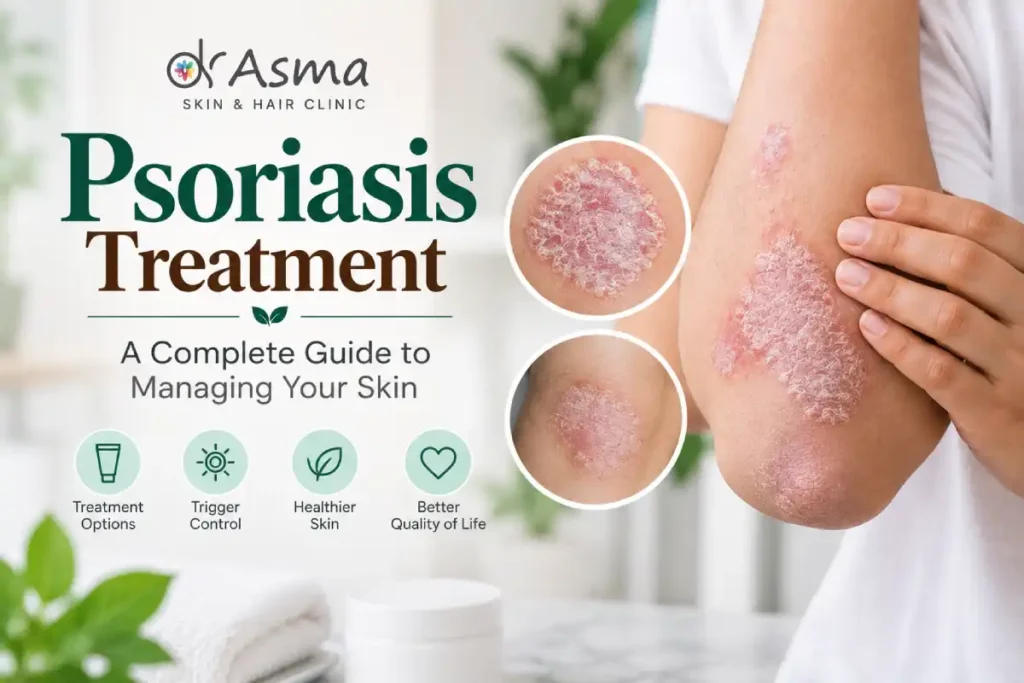
For many people, psoriasis comes and goes in cycles — flaring for weeks or months, then calming down or even clearing. But without proper management, it can significantly affect your quality of life.
Psoriasis is manageable. With the right treatment plan, you can reduce flare-ups, soothe your skin, and regain control.
At our clinic, we see patients every week who are struggling with psoriasis. Many have tried multiple creams and remedies without lasting
relief.What matters most is identifying your personal triggers and selecting a treatment plan that suits your condition.
What Is Psoriasis?
Psoriasis is a systemic, immune-mediated inflammatory skin disease . It develops when the immune system wrongly targets healthy skin cells, triggering them to multiply at an abnormally fast rate.
Key facts about psoriasis:
| Fact | Details |
| Prevalence | Affects 0.44–2.8% of the Indian population |
| Nature | Chronic, non-contagious, and relapsing-remitting |
| Age of onset | Can occur at any age, from infancy to late adulthood |
| Associated conditions | Psoriatic arthritis, metabolic syndrome, inflammatory bowel disease |
Common Types of Psoriasis
| Type | Appearance | Location |
| Plaque Psoriasis | Red patches with silvery scales | Elbows, knees, scalp, lower back |
| Guttate Psoriasis | Small, teardrop-shaped spots | Trunk, arms, legs |
| Pustular Psoriasis | Pus-filled blisters | Palms, soles |
| Inverse Psoriasis | Smooth, red patches | Skin folds (groin, underarms, under breasts) |
Chronic plaque psoriasis is the most frequently seen type, accounting for 80–90% of all psoriasis cases.
What Triggers Psoriasis Flare-Ups?
Psoriasis triggers vary from person to person. Knowing your triggers helps you avoid flare-ups.
| Trigger | How It Affects You |
| Infections | Strep throat, colds, and other infections can trigger flares |
| Skin injury | Any injury to the skin — including cuts, scrapes, bug bites, or sunburn — may lead to new patches |
| Stress | Chronic or acute stress worsens psoriasis |
| Medications | Lithium, antimalarials, and some anti-inflammatories can trigger flares |
| Weather | Cold, dry weather often worsens symptoms; sunlight can help |
| Smoking & Alcohol | Both increase flare frequency and severity |
Psoriasis Treatment Options
Treatment depends on the severity of your psoriasis, the areas affected, and how much it impacts your daily life. Using more than one treatment together often gives the best results
1. Topical Treatments (For Mild to Moderate Psoriasis)
Topical treatments are products that you apply straight onto the affected areas. Nearly everyone with psoriasis benefits from moisturizers (emollients) .
| Treatment | What It Does |
| Corticosteroids | Reduce inflammation and itching |
| Vitamin D Analogues (Calcipotriene) | Slow skin cell growth |
| Coal Tar | Reduces scaling and inflammation |
| Salicylic Acid | Thins thick plaques, helps other treatments penetrate |
| Tacrolimus/Pimecrolimus | Used for delicate areas like face and skin folds |
2. Phototherapy (Light Therapy)
Phototherapy involves exposing the skin to measured doses of ultraviolet light to reduce rapid cell turnover. It is typically recommended for moderate to severe cases that cover larger areas of the body.
| Type | Details |
| Narrowband UVB (NBUVB) | Most common; safe and effective without psoralens |
| PUVA | Psoralen + UVA; used for severe cases |
| Excimer Laser | Targeted UV light for specific patches |
3. Systemic Treatments (For Moderate to Severe Psoriasis)
Systemic treatments affect the whole body. They are prescribed when topical treatments and phototherapy are not enough .
| Treatment | How It Works |
| Methotrexate | Reduces inflammation and slows skin cell growth |
| Cyclosporine | Suppresses the immune system |
| Acitretin (Retinoid) | Reduces inflammation and skin cell turnover |
| Apremilast | Oral small-molecule medication for plaque psoriasis |
4. Biologic Therapies (Advanced Treatment)
Biologics represent the newest and most targeted option for moderate to severe psoriasis. They target specific parts of the immune system .
| Biologic Class | Examples |
| TNF Inhibitors | Etanercept, adalimumab, infliximab |
| IL-17 Inhibitors | Secukinumab, ixekizumab |
| IL-23 Inhibitors | Guselkumab, risankizumab, tildrakizumab |
Important: Biologics are prescription-only and require specialist supervision. They have transformed the treatment of severe psoriasis, with many patients achieving clear or almost clear skin .
Why Early Treatment Matters
Recent research shows that early intervention in psoriasis can lead to better long-term outcomes. Patients with short disease duration respond better to treatment and may achieve longer remission periods .
The GUIDE trial demonstrated that patients with early disease duration (≤2 years) achieved higher rates of complete skin clearance compared to those with longer-standing disease .
The message: Do not wait. Early treatment can modify the course of your psoriasis.
Lifestyle Measures That Help
Beyond medical treatment, these lifestyle changes support better outcomes :
| Measure | Benefit |
| Maintain healthy weight | Reduces inflammation and severity |
| Quit smoking | Smoking worsens psoriasis |
| Reduce alcohol | Alcohol triggers flares |
| Manage stress | Stress is a major trigger |
| Use moisturizers daily | Keeps skin hydrated and reduces scaling |
When to See a Dermatologist
See a dermatologist if:
- You have thick, scaly patches that do not improve with moisturizers
- Your psoriasis affects more than 10% of your total body area
- Topical treatments are not working or are not tolerated
- You have joint pain or swelling (possible psoriatic arthritis)
- Your daily life and well-being are being noticeably impacted by psoriasis
Psoriasis Treatment at Dr. Asma Skin Clinic
At Dr. Asma Skin Clinic, we offer comprehensive care for psoriasis patients. Psoriasis treatment in Lucknow is tailored to your specific type, severity, and lifestyle.
Our approach includes:
- Accurate diagnosis and severity assessment
- Topical therapy with prescription-strength medications
- Phototherapy (NBUVB) for extensive involvement
- Systemic and biologic therapy coordination for severe cases
- Lifestyle counseling and trigger management
About Dr. Asma Parveen
Dr. Asma Parveen is a board-certified dermatologist with 14+ years of experience in Lucknow. She specializes in chronic skin conditions including psoriasis, eczema, and autoimmune skin disorders.
At our Chowk clinic, we offer:
- Personalized psoriasis management plans
- Medical-grade topical treatments
- Phototherapy services
- Long-term follow-up and support
Frequently Asked Questions
- Is psoriasis contagious?
No. Psoriasis is an autoimmune disease and is not contagious in any way.
- Can psoriasis be cured?
There is no permanent cure, but treatments can effectively manage symptoms and achieve long periods of clear skin. Research into early intervention and advanced therapies is promising .
- What is the best treatment for psoriasis?
The right treatment varies based on how severe your psoriasis is, where it appears, and your overall health. Mild cases usually improve with topical creams, while moderate to severe cases may require light therapy, oral medications, or biologic injections.
- Does diet affect psoriasis?
Eating well supports your overall health, and maintaining a healthy weight may reduce symptom severity. Certain foods can trigger flare-ups in some people — tracking your meals can help you spot these patterns.
- Can stress cause psoriasis?
Stress is not the root cause of psoriasis, but it frequently sets off flare-ups in many patients.
Ready to Take Control of Your Psoriasis?
You do not have to let psoriasis dictate your daily life. With the right treatment plan — and a dermatologist who understands the condition — you can manage flare-ups and enjoy clearer skin.
Visit our Clinics:
Dr. Asma M.D. Skin Clinic – Chowk, Lucknow
Subhash Chandra Bose Complex, Mandi Crossing, Victoria Street, Chowk Lucknow – 226003
Dr. Asma Skin & Hair Clinic – Thakurganj, Lucknow
Near Ghante Wala Sweets, Daulatganj Thakurganj, Lucknow – 226003
Dr. Asma Skin Clinic – Barabanki
Mohalla Ayodhya Nagar, Naka, Satrikh, Barabanki – 225001
Call/WhatsApp to Book Your Appointment: +91-9335312242
New patients: 10% off first consultation