
You look in the mirror and notice dark patches on your skin. Your first thought: “Is this melasma? Or just regular pigmentation?”
You are not alone. Many patients visit my Chowk clinic with this exact confusion.
Here is the truth: Melasma and hyperpigmentation are not the same thing.
While both cause dark spots on your skin, they differ in causes, appearance, and treatment. Using the wrong treatment can waste your time and money — and sometimes make your skin worse.
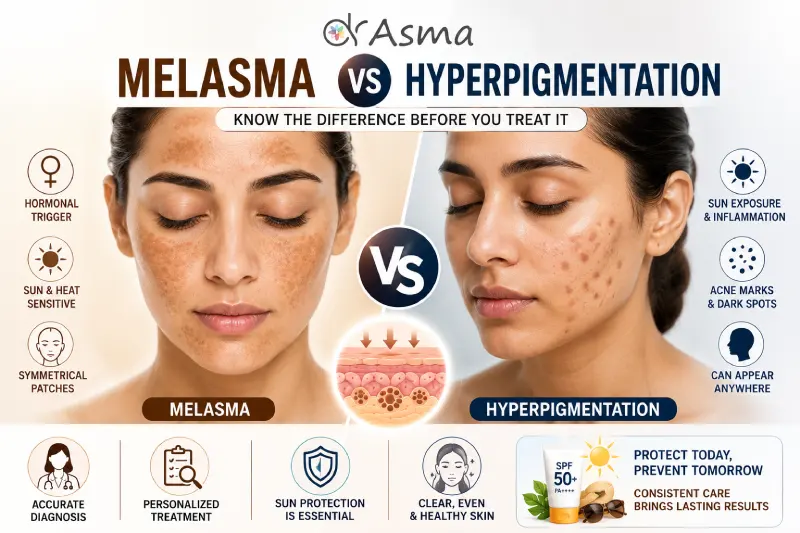
In this guide, We will help you understand the difference between melasma and other forms of hyperpigmentation. You will learn how to identify what you have, why it matters, and what treatments actually work.
What Is Hyperpigmentation?
Hyperpigmentation is a broad term. It refers to any darkening of the skin caused by excess melanin production.
Think of it as an umbrella term that covers many different conditions.
Common types of hyperpigmentation:
| Type | What It Is |
| Sun spots | Dark spots from years of sun exposure |
| Post-inflammatory hyperpigmentation (PIH) | Dark marks left after pimples, cuts, or rashes heal |
| Freckles | Small brown spots, often genetic |
| Melasma | Hormone-triggered patches on the face |
Key feature: Hyperpigmentation can appear anywhere on your body. It is usually triggered by sun exposure, inflammation, or injury to the skin.
What Is Melasma?
Melasma is a specific type of hyperpigmentation. It is not the same as a sun spot or a post-acne mark.
Key features of melasma:
- Appears as brown or grey-brown patches
- Usually on the face — cheeks, forehead, nose, upper lip, chin
- Often symmetrical (appears on both sides of the face)
- Triggered by hormones, sun exposure, and heat
- More common in women (especially during pregnancy or on birth control pills)
The medical term for melasma: Chloasma (often called the “mask of pregnancy” when it appears during pregnancy).
Key Differences: Melasma vs Other Hyperpigmentation
| Feature | Melasma | Other Hyperpigmentation |
| Location | Face (cheeks, forehead, nose, upper lip, chin) | Anywhere on body (face, arms, hands, back, legs) |
| Appearance | Symmetrical, blotchy patches with irregular borders | Spots or patches with defined edges |
| Triggers | Hormones + sun + heat | Sun exposure, inflammation, injury, medications |
| Who gets it | More common in women, especially during pregnancy or on hormonal medication | Affects both men and women equally |
| Seasonal changes | Often gets darker in summer, lighter in winter | Usually stable, may darken slightly with sun exposure |
| Treatment approach | Needs specific protocols (pigment stabilizers + sun protection with iron oxide) | Can be treated with standard pigment-lightening approaches |
Why Accurate Diagnosis Matters
This is the most important part.
Using the wrong treatment can make your condition worse.
What happens when you treat melasma like regular pigmentation:
| Wrong Treatment | What Happens |
| Strong chemical peels | Can trigger more pigmentation (melasma worsens) |
| Aggressive laser | Can cause rebound pigmentation |
| Harsh exfoliants | Irritates skin, triggers more melanin production |
| Ignoring sun protection | Melasma gets darker, more stubborn |
The right approach:
- Get a proper diagnosis from a dermatologist
- Understand your specific type of pigmentation
- Use treatments designed for your condition
- Follow a customized plan with sun protection
How to Tell If You Have Melasma
Ask yourself these questions:
Question 1: Are the dark patches on your face symmetrical (both cheeks, both sides of forehead)?
- Yes → Likely melasma
- No → Could be other pigmentation
Question 2: Does your skin get darker in summer and lighter in winter?
- Yes → Likely melasma
- No → Could be other pigmentation
Question 3: Are you pregnant, on birth control pills, or taking hormone medication?
- Yes → Likely melasma (hormonal trigger)
- No → Could be other pigmentation
Question 4: Did the dark patches appear after a pimple, cut, or rash?
- Yes → Likely post-inflammatory hyperpigmentation (PIH)
- No → Could be melasma
When to See a Dermatologist
You can manage mild pigmentation with over-the-counter products. But see a dermatologist if:
| Sign | Why |
| Your dark patches are spreading | Needs professional evaluation |
| Home treatments are not working | You need prescription-strength options |
| You have melasma on your face | Requires specific treatment protocols |
| Your skin is getting darker despite using sunscreen | Your sunscreen may not be effective for melasma |
| You are pregnant or planning pregnancy | Safe treatment options are needed |
| You are unsure what type of pigmentation you have | Accurate diagnosis is essential |
Treatment Options at Dr. Asma Skin Clinic, Chowk
Once you have a proper diagnosis, we offer personalized treatment plans:
For Melasma:
| Treatment | How It Works |
| Prescription creams | Hydroquinone, tretinoin, kojic acid, azelaic acid |
| Chemical peels | Gentle peels to remove surface pigment |
| Cosmelan peel | Specialized melasma treatment |
| Tranexamic acid | Oral or topical for stubborn melasma |
| Sunscreen with iron oxide | Blocks visible light that triggers melasma |
For Other Hyperpigmentation:
| Treatment | How It Works |
| Chemical peels | Removes surface pigmentation |
| Q-Switch laser | Breaks down deeper pigment |
| Microneedling | Stimulates collagen, fades dark spots |
| Topical creams | Kojic acid, vitamin C, niacinamide |
Prevention Tips for Both Conditions
| Action | Why |
| Wear SPF 50+ sunscreen daily | Prevents darkening of all pigmentation |
| Use tinted sunscreen with iron oxide | Essential for melasma (blocks visible light) |
| Wear a hat and sunglasses | Physical protection from UV rays |
| Avoid peak sun hours (12 PM – 4 PM) | Reduces UV and heat exposure |
| Do not pick or pop pimples | Prevents post-inflammatory pigmentation |
| Treat skin inflammation promptly | Reduces risk of dark marks |
Frequently Asked Questions
Q: Can melasma be cured permanently?
A: Melasma is often chronic. It can be managed and kept under control, but it may require long-term maintenance. Sun protection is essential even after treatment.
Q: Is laser safe for melasma?
A: Yes, but only with the right laser and settings. Q-Switch Nd:YAG lasers are commonly used. Aggressive lasers can worsen melasma. Always choose an experienced dermatologist.
Q: What is the difference between melasma and PIH?
A: PIH (post-inflammatory hyperpigmentation) appears after inflammation like a pimple or cut. Melasma is triggered by hormones and sun. PIH can appear anywhere, melasma is usually on the face.
Q: Can I use the same cream for melasma and other pigmentation?
A: Not always. Melasma often needs specific combinations. Some creams that work for sun spots may not work for melasma. See a dermatologist for the right prescription.
Q: Does diet affect melasma?
A: Diet does not directly cause melasma. But anti-inflammatory foods can support overall skin health. Sun protection is far more important.
About Dr. Asma Parveen
Dr. Asma Parveen is a board-certified dermatologist with 14+ years of experience in Lucknow. She specializes in pigmentation disorders, melasma, and post-acne marks.
At our clinic, We offer:
- Accurate diagnosis using dermatoscopy
- Customized treatment plans for melasma and hyperpigmentation
- Medical-grade sunscreens with iron oxide
- Cosmelan peel, chemical peels, and laser treatments
Ready to Get Clear, Even Skin?
Not sure whether you have melasma or another type of pigmentation? Let us help you get the right diagnosis and treatment.
Visit Our Clinic
Dr. Asma MD Skin Clinic – Chowk, Lucknow
Subhash Chandra Bose Complex, Mandi Crossing, Victoria Street, Chowk Lucknow – 226003
Dr. Asma Skin & Hair Clinic – Thakurganj, Lucknow
Near Ghante Wala Sweets, Daulatganj Thakurganj, Lucknow – 226003
Dr. Asma Skin Clinic – Barabanki
Mohalla Ayodhya Nagar, Naka, Satrikh, Barabanki – 225001
Call/WhatsApp to Book Your Appointment: +91-9335312242
New patients: 10% off first consultation