
Male pattern baldness is one of the most common concerns we see at our Chowk clinic. Men notice their hairline changing, their crown thinning, or more hair on their pillow — but they do not know if it is serious, what stage they are in, or what to do about it.
Here is the truth: Male pattern baldness is progressive. It does not stop on its own. But the earlier you understand your stage, the more hair you can preserve.
In this guide, we will walk you through the 7 stages of male pattern baldness (also called the Norwood Scale), what each stage means, and the treatment options available at every stage.

What Is Male Pattern Baldness?
Male pattern baldness (androgenetic alopecia) is the most common type of hair loss in men. It affects millions of men worldwide, and its prevalence increases with age.
What causes it?
| Factor | How It Works |
| Genetics | Inherited from either parent — not just your mother’s father |
| Hormones (DHT) | Dihydrotestosterone shrinks hair follicles over time |
| Age | Risk increases significantly after 30 |
| Other factors | Stress, poor nutrition, and some medications can accelerate hair loss |
How it progresses:
- Hair follicles gradually shrink (miniaturization)
- Hair becomes thinner and shorter with each growth cycle
- Eventually, the follicle stops producing visible hair
Male pattern baldness follows a predictable pattern in most men. This is why doctors use a classification system called the Norwood Scale to identify the stage.
Male Pattern Baldness vs. Other Types of Hair Loss
Not all hair loss is male pattern baldness. Here is how to tell the difference.
| Type | Key Difference |
| Male Pattern Baldness | Gradual, follows Norwood pattern, genetic |
| Telogen Effluvium | Sudden shedding, often stress or illness-related |
| Alopecia Areata | Patchy bald spots, autoimmune |
| Traction Alopecia | Caused by tight hairstyles |
If you are unsure which type you have, a dermatologist can diagnose it accurately.
The 7 Stages of Male Pattern Baldness (Norwood Scale Explained)
The Norwood Scale was developed by Dr. James Hamilton and later refined by Dr. O’Tar Norwood. It classifies male pattern baldness into 7 stages, plus a Type A variant.
Here is what each stage looks like.
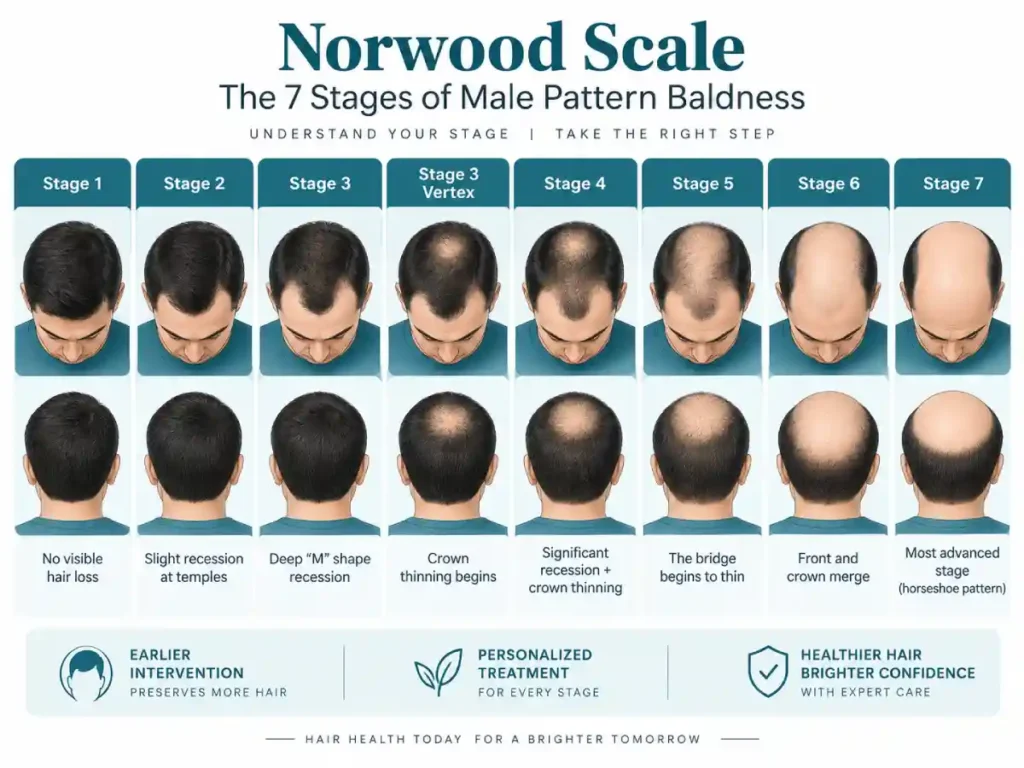
Stage 1: No Visible Hair Loss
- Hairline is intact
- No noticeable thinning
- This is the baseline — no balding present
What it means: If you are at Stage 1, you are not experiencing male pattern baldness yet. However, if you have a family history, it is wise to monitor your hair.
Stage 2: Slight Recession at Temples
- Mild recession at the temples
- Hairline takes on a slight “M” or “V” shape
- Not yet considered balding by medical standards
What it means: Early changes may be beginning. This is the best time to consult a dermatologist if you have a family history of baldness.
Stage 3: Deep “M” Shape Recession
- Deep recession at the temples
- Hairline forms a distinct “M” shape
- This is the first stage considered actual balding
What it means: Hair loss has officially begun. Treatment started at this stage has the highest chance of preserving existing hair.
Stage 3 Vertex: Crown Thinning Begins
- Temples remain receded (as in Stage 3)
- Crown (top of the head) begins to thin
- A bald spot may start forming at the back
What it means: Hair loss is now affecting two areas — the front and the crown. Treatment is still highly effective.
Stage 4: Significant Recession + Crown Thinning
- Front recession is deeper
- Crown thinning is more pronounced
- A bridge of hair still separates the front and crown
- The balding areas are distinct
What it means: Moderate hair loss. Combination therapy (PRP + medications) works well at this stage.
Stage 5: The Bridge Begins to Thin
- The bridge of hair between the front and crown becomes thinner
- The two balding areas start to merge
- Overall hair density is noticeably reduced
What it means: Advanced hair loss. Treatment can still slow progression and improve density, but regrowth may be limited.
Stage 6: Front and Crown Merge
- The bridge of hair is mostly gone
- Front and crown balding areas have merged into one large area
- Hair remains on the sides and back (the “horseshoe” pattern begins)
What it means: Significant hair loss. PRP and medications can help maintain remaining hair, but regrowth is limited.
Stage 7: Most Advanced Stage
- Only a horseshoe-shaped band of hair remains on the sides and back
- The top of the head is largely bald
- This is the most advanced stage of male pattern baldness
What it means: At this stage, medical treatments have limited effectiveness for regrowth. Hair transplant may be the only option for restoring hair in bald areas.
Type A Variant
Not all men follow the standard Norwood pattern. The Type A variant is different.
| Feature | Type A Variant |
| Pattern | Receding hairline moves forward without crown involvement |
| Crown | Usually remains intact |
| Progression | Can be faster than standard pattern |
Why it matters: Treatment approach may differ for Type A. A dermatologist can identify which pattern you have.
How Is Male Pattern Baldness Diagnosed?
A proper diagnosis includes:
| Test | Purpose |
| Scalp Examination | Visual assessment of pattern |
| Hair Pull Test | Checks shedding rate |
| Trichoscopy | Magnified view of hair follicles |
| Blood Tests | Rule out thyroid, iron, vitamin D, B12 deficiencies |
This helps confirm male pattern baldness and rule out other causes.
What Each Stage Means for Treatment
Treatment should match your stage. Here is a general guide.
| Stage | Treatment Approach |
| Stages 1-2 | Prevention, medical management (if family history) |
| Stage 3 | PRP therapy, medications (Minoxidil, Finasteride) |
| Stages 4-5 | Combination therapy: PRP + medications |
| Stages 6-7 | PRP + medications to maintain remaining hair; hair transplant evaluation |
Can Male Pattern Baldness Be Prevented?
There is no cure for male pattern baldness, but progression can be slowed — and sometimes reversed — with early treatment.
| Prevention Strategy | How It Helps |
| Early treatment | Preserves hair follicles before they die |
| Medications | Minoxidil, Finasteride can slow progression |
| PRP therapy | Stimulates hair growth |
| Healthy lifestyle | Reduces stress, supports overall hair health |
The key message: The earlier you start, the more hair you keep.
Why Early Intervention Matters
This is the most important message of this guide.
Hair follicles can be saved in early stages. Once a follicle dies, it cannot regrow.
At Stage 2 or 3, your hair follicles are still alive but shrinking. Treatment can reverse this process and preserve your hair.
At Stage 6 or 7, many follicles have stopped producing hair entirely. Treatment can only do so much.
The earlier you act, the more hair you keep.
When to See a Dermatologist
Do not wait until you are bald. See a dermatologist if:
| Sign | Why |
| You notice a receding hairline | Early stage = better outcomes |
| Your crown feels thinner | Could indicate Stage 3 Vertex |
| You are shedding more than usual | Rule out other causes |
| You have a family history of baldness | Preventive treatment may help |
| You want to know your stage | Accurate diagnosis guides treatment |
Treatment Options at Dr. Asma Skin Clinic
At our Chowk clinic, we offer comprehensive hair loss treatments tailored to your stage.
| Treatment | How It Works | Best For |
| Minoxidil (Topical) | Improves blood flow to follicles | Early to moderate stages |
| Finasteride (Oral) | Blocks DHT production | Moderate stages |
| PRP Therapy | Growth factors stimulate follicles | All stages (except late) |
| GFC Treatment | Advanced PRP alternative | Moderate stages |
| Hair Transplant | Moves hair from donor area | Advanced stages |
When to Consider a Hair Transplant
| Consideration | Details |
| Best candidates | Stages 4-6, stable hair loss |
| Not suitable for | Stage 7 (limited donor hair) |
| What it does | Moves hair from back/sides to bald areas |
| What it cannot do | Stop future hair loss — medications still needed |
A dermatologist can tell you if you are a good candidate.
Cost of Hair Loss Treatments in Lucknow
At our clinic, we believe in transparent pricing.
| Treatment | Cost Range (₹) |
| PRP Therapy | ₹3,000 – ₹6,000 per session |
| GFC Treatment | ₹5,000 – ₹8,000 per session |
| Medications | ₹500 – ₹1,500 per month |
| Hair Transplant | ₹80,000 – ₹3,00,000 (depending on grafts) |
Factors affecting cost: Severity of hair loss, number of sessions, and treatment combination.
Common Myths About Male Pattern Baldness
| Myth | Fact |
| “Baldness only comes from your mother’s father” | Genetics come from both sides |
| “Wearing hats causes baldness” | No scientific link |
| “Stress causes permanent baldness” | Stress can trigger shedding, not pattern baldness |
| “Hair loss stops on its own” | Male pattern baldness is progressive |
The Emotional Impact of Hair Loss
Hair loss is not just physical — it affects how you feel about yourself.
| Impact | How to Cope |
| Lower confidence | Understand it is common and treatable |
| Anxiety about appearance | Early treatment reduces worry |
| Feeling of losing control | Taking action restores control |
You are not alone. Millions of men experience this. And there is help.
Frequently Asked Questions
Q: Can hair grow back at Stage 3?
A: Yes. At Stage 3, hair follicles are still alive. PRP and medications can preserve and even regrow hair.
Q: Is Stage 7 reversible?
A: At Stage 7, many follicles have stopped producing hair. Medical treatments have limited effectiveness for regrowth. Hair transplant may be the only option for restoring hair in bald areas.
Q: How fast does male pattern baldness progress?
A: It varies. Some men lose hair over decades; others progress quickly. Genetics play a major role.
Q: What is the difference between Norwood and Ludwig scale?
A: Norwood Scale is used for male pattern baldness. Ludwig Scale is used for female pattern hair loss.
Q: Can PRP help at Norwood stage 4?
A: Yes. PRP works well at Stage 4, especially when combined with medications.
Q: When should I see a dermatologist for hair loss?
A: As soon as you notice changes. Early intervention preserves more hair.
Q: Does male pattern baldness affect women?
A: Women can also experience pattern hair loss, classified by the Ludwig Scale. If you are a woman noticing thinning, consult a dermatologist.
About Dr. Asma Parveen
Dr. Asma Parveen is a board-certified dermatologist with 14+ years of experience in Lucknow. She specializes in hair disorders, PRP therapy, and scalp conditions.
At our Chowk clinic, we offer:
- Complete hair fall assessment
- Stage identification (Norwood Scale)
- PRP and GFC treatments
- Prescription hair medications
- Long-term maintenance plans
Ready to Take Control of Your Hair Loss?
Do not wait until you are bald. Understand your stage and start treatment today.
Visit our Clinics:
Dr. Asma M.D. Skin Clinic – Chowk, Lucknow
Subhash Chandra Bose Complex, Mandi Crossing, Victoria Street, Chowk Lucknow – 226003
Dr. Asma Skin & Hair Clinic – Thakurganj, Lucknow
Near Ghante Wala Sweets, Daulatganj Thakurganj, Lucknow – 226003
Dr. Asma Skin Clinic – Barabanki
Mohalla Ayodhya Nagar, Naka, Satrikh, Barabanki – 225001
Call/WhatsApp to Book Your Appointment: +91-9335312242
New patients: 10% off first consultation